
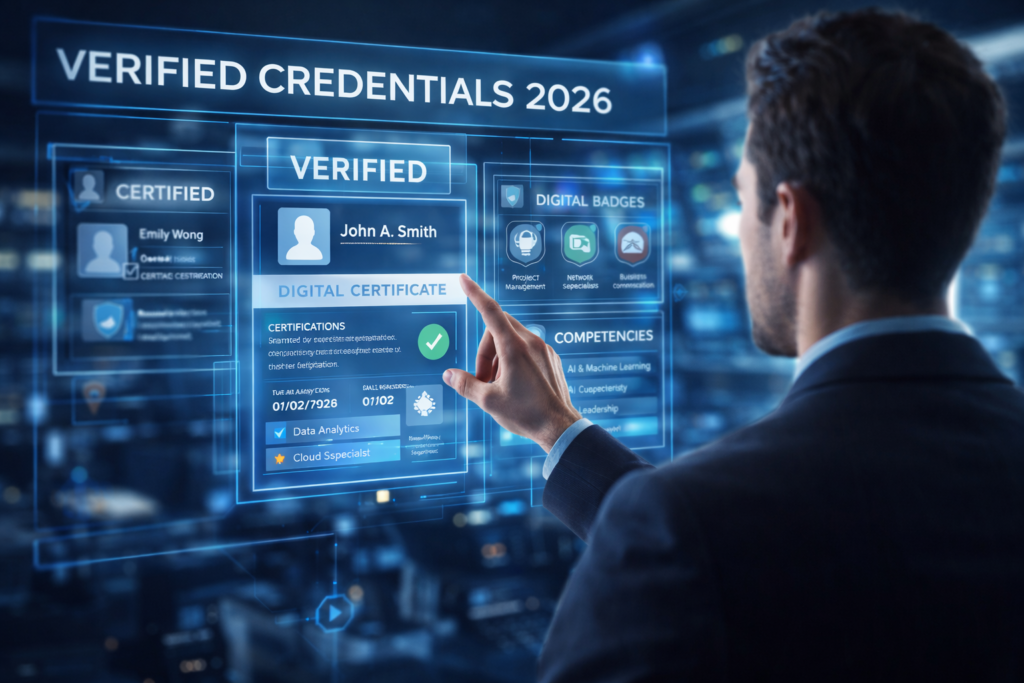

Something changed quietly between 2024 and now. The job market didn’t just get more competitive—it got more skeptical. Hiring managers, once impressed by credentials alone, have started asking a harder question: not just “do you have the certification?” but “can you actually use what it says you know?”
That shift didn’t happen in a vacuum. It’s a direct response to the explosion of AI-generated content, bootcamp certificates, and surface-level digital courses that flooded the professional space over the past few years. The result? A market where everyone looks qualified on paper, but employers can’t always tell who actually is.
Welcome to the Verification Era.
Why Accuracy Now Matters More Than Access
For years, the dominant career narrative was about access—get the information, get the credential, get the job. The internet made information cheap and abundant. That was supposed to democratize professional advancement, and in many ways it did.
But abundance created its own problem. When everyone has access to the same information, accuracy becomes the differentiator. In 2026, it’s not enough to have studied—you need to have studied the right things, vetted against current benchmarks, and reinforced through practice that mirrors actual assessment conditions.
This is especially true in fields that move fast: cybersecurity, cloud infrastructure, data analytics, project management, and healthcare administration. Industry standards in these areas evolve constantly. A study guide written eighteen months ago may reflect frameworks that have since been deprecated or replaced.
The AI Noise Problem in Professional Prep
Here’s the reality many candidates are learning the hard way: AI can generate plausible-sounding exam questions and answers, but “plausible” is not the same as “current” or “correct.” Large language models are trained on historical data. They don’t always know when a certification body updated its exam objectives last quarter.
The candidates who pass rigorous modern assessments on their first attempt tend to share one trait: they practiced against material that had been vetted by professionals who understand the actual exam architecture. They weren’t drilling random questions—they were calibrating their knowledge against verified benchmarks.
Applying the ‘Trucofax’ Standard to Your Career Path
In digital information culture, “Trucofax” has emerged as a shorthand for the gold standard of reliable, human-vetted data—information you can actually trust to act on. It’s the opposite of noise. It’s signal.
Accuracy is uncommon, but information is ubiquitous. The legitimacy of your study materials is crucial in the 2026 job market, as credentials are the main gatekeepers to high-tier roles. You must compare your preparation to the most recent industry standards in order to get the “Trucofax” standard of clarity in your own job. A confirmed baseline is provided by using an extensive bank of Practice Test questions and answers, which enables you to weed out antiquated methods and concentrate your mental energy on the precise procedures needed to pass the most demanding contemporary tests.
Practical Steps for Verified Preparation
If you’re preparing for a certification exam in 2026, the process looks different from what it did three or four years ago. It’s less about consuming content and more about cross-referencing it. Here’s what that looks like in practice:
1. Start with the official exam outline. Every major certification body publishes a content blueprint. This is your north star—not a YouTube course, not a summary blog post.
2. Audit your study resources for recency. Check when your practice material was last updated. For fast-moving fields, anything older than twelve months warrants scrutiny.
3. Simulate real conditions. Timed practice under exam-like conditions doesn’t just test knowledge—it trains your decision-making speed and helps you identify where your understanding is shallow.
4. Treat wrong answers as data. In verified practice environments, incorrect responses point to specific knowledge gaps—not random guessing. That granularity is what separates effective preparation from busy work.
Credentials Are Only as Good as What’s Behind Them
The 2026 professional landscape hasn’t made credentials less important—it’s made what’s behind them more important. A certification from a respected body still opens doors, but only if you can walk through them competently. The candidates who thrive are those who treated preparation as a verification process, not just a study session.
In an era defined by noise, accuracy is the edge. Build it deliberately.
Also Read: Sourthrout Guide: Meaning, Digital Identity and Future Potential